Artworks such as these are created and offered as cosmological maps
The ANU Art Collection was established in 1949, three years after The Australian National University itself. It holds more than 2900 works by prominent artists. It also contains one of the finest and most wide-ranging collections of Indigenous art held by any Australian university. These significant works, displayed throughout the ANU Campus, serve to advance the status, recognition, and lives of Australia’s First Peoples.
In 1959 the Murrinh-Patha artist Nym Bandak from Wadeye in the Northern Territory produced a series of paintings in response to a request by ANU anthropologist W.E.H. Stanner. These works were among the earliest examples of Aboriginal art to be widely exhibited in Australia and tour the world. One of them, Body Designs for Ceremony (1959),is still on display in the H.C. Coombs building lobby.
Other groundbreaking Indigenous art displays took place on campus in Melville Hall and at the A.D. Hope building in the 1970s, thanks to the Yolŋu artists Narritjin and Banapana Maymuru (ANU Creative Arts Fellows, 1978). ANU Emeritus Professor Howard Morphy’s anthropology fieldwork at Yirrkala in northeast Arnhem Land led to him asking them to create these works, still on display near the Classics Museum in the A.D. Hope building.
Narritjin Maymaru’s paintings on eucalyptus bark speak of the shared experience between the artist, students, and ANU community during his H.C. Coombs Creative Arts Fellowship. In a joining of two worlds, they were made with ochres from his home Country and produced alongside University students in a makeshift studio at Melville Hall.
The Lowitja O’Donoghue Cultural Centre and Research School for Social Sciences buildings boast extraordinary large-scale works by female Western Desert artists such as Naata Nungurrayi, Esther Giles Nampitjinpa, and Tjawina Porter Nampitjinpa.
Careful custodians
The ANU Art Collection is curated and managed by the University’s Drill Hall Gallery team. The Gallery’s dedication to Australian Indigenous art is a feature of its programming. It has hosted several key exhibitions that have illuminated the depth and breadth of Aboriginal and Torres Strait Islander art and artists. These shows explore the aesthetic richness of the Indigenous visual culture and foster a deeper understanding and appreciation among audiences for ancient yet living traditions.
“The ambition to make art an integral part of the university experience goes back to the inauguration of ANU,” says Drill Hall Gallery Curator, Oscar Capezio.
“The ANU Art Collection mirrors the University’s foundational aspiration to realise Australia’s creative and intellectual potential, while celebrating its cultural complexity. The Collection’s extensive representation of art by Australia’s First Peoples, plays a key part in achieving this goal.”
“Many treasured works displayed in the ANU Art Collection demonstrate the capacity of art to transcend cultural and geographic boundaries and establish intellectual and political affinities. The fruitful cross-cultural friendship between Murrinh-Patha artist Nym Bandak and ANU Anthropologist William Stanner is celebrated through the display of Bandak’s paintings on Masonite board. Painted for Stanner in 1958, these map all known things within the Murrinh-Patha understanding. They are a response to topographic maps that Stanner shared with Bandak and a testament to their open and respectful cultural exchange."
Cross-cultural respect
“These engagements are foundational to cross-cultural dialogues between ANU researchers and remote Indigenous communities, and the Art Collection reflects this. In building on the unique strengths and composition of the Collection, we strive to maintain the commitment made by ANU researchers decades ago to certain Indigenous communities when they engaged in a dialogue of intellectual exchange and mutual respect. In acquiring works by many ancestors and their descendants, the Drill Hall Gallery and ANU Art Collection maintains our commitment to these communities – such as the Yolŋu community at Buku-Larrnggay Mulka Centre in Yirrkala – enriching the campus with the generational transference of these sacred stories,” says Oscar.
“The bark paintings by Yolŋu artists within the ANU Collection demonstrate the generosity and willingness that Indigenous Australians have shown. Artworks such as these are created and offered as cosmological maps performed to express clan identity. They provide a sacred charter to the land. Over the many decades that they have been displayed at ANU, these works have become an important means for non-Indigenous audiences to gain insight into the depth and complexity of Indigenous cosmology, and the principles that define their ceremonial enactment. This is a vital component of Indigenous art.”
“As ANU Emeritus Professor of Anthropology Howard Morphy reminds us, Indigenous artworks ‘are here because of the agency of Indigenous Australians who want them to be here. They want people to see how important Australian Aboriginal art and culture should be in the minds of non-Indigenous Australians’.”
Oscar says that given the mediatory role of Indigenous art in postcolonial Australia, the Collection reveals important insights for a process of mutual recognition. “Through sharing these stories with our community and promoting Indigenous voices, we hope to foster a form of reciprocal self-recognition, declaring political agency in complex, affective, and overlapping ways,” he says.
Murrinh-Patha artist Nym Bandak from Wadeye in the Northern Territory produced a series of paintings in response to a request by ANU anthropologist W.E.H. Stanner in 1959. They were among the earliest examples of Aboriginal art to be widely exhibited in Australia and tour the world. One of them, Body Designs for Ceremony (1959),is on display in the H.C. Coombs building lobby.
Narritjin Maymaru’s paintings on eucalyptus bark speak of the shared experience between the artist, students, and ANU community during his H.C. Coombs Creative Arts Fellowship. In a joining of two worlds, they were made with ochres from his home Country and produced alongside University students in a makeshift studio at Melville Hall.
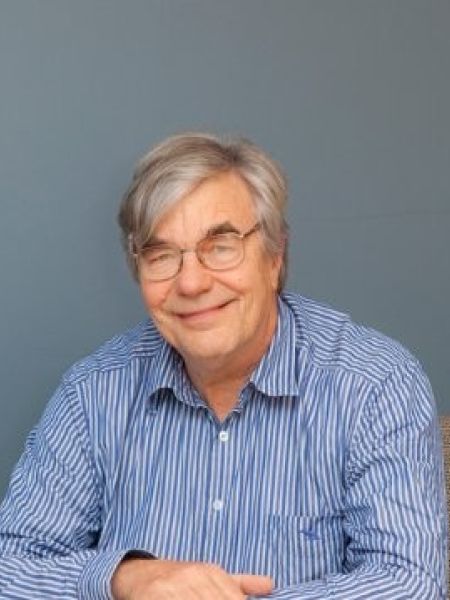
"Indigenous artworks are here [at ANU] because of the agency of Indigenous Australians who want them to be here. They want people to see how important Australia Aboriginal art and culture should be," says Emeritus Professor Howard Morphy (pictured, right) whose work with Yolŋu people at Yirrkala in northeast Arnhem Land led to the creation of several works on display to this day.
Powerful work in the office of First Nations leader
By Drill Hall Gallery Curator Oscar Capezio
Hanging in the office of ANU Vice-President (First Nations) Professor Peter Yu is a sublime painting by an artist who captures the topography of the desert near Professor Yu’s traditional Yawuru Country in the Kimberley, and the presence of the unforeseen forces within.
In contrast to the modern antipodean vision of the Australian landscape as a site of alienation and psychological inquiry, Rover Joolama Thomas painted from within Country – conveying its living spirit, memory, and ancestral presence.
Joolama was born at Yalda soak, near Well 33 on the Canning Stock Route, Great Sandy Desert/Kimberley, Western Australia, in 1926 (dec. 1998). His people are the Kukatja and Wangkajunga language groups of the Western Desert region.
By the time Joolama settled in Warmun (Turkey Creek) in the 1980s to develop his innovative painting, he had already moved far from his homelands and travelled all across the East Kimberley. He spent a life working as stockman on various cattle stations, approaching the land with an uncomfortable mix of utilitarian purpose and spiritual sensitivity.
Joolama amalgamates these various topographies by adapting the formal power of Kimberley visual traditions – rock art, body painting, and ceremonial design – to animate the ancestral narratives of place. Through an ongoing revelation, the artist and the painting repeatedly assert the primacy of Country as a sentient, autonomous presence.
In Nyila Country, Canning Stock Route, Joolama maps the undulating topography of the Tanami and Great Sandy deserts through an aerial and lateral synthesis of perspective and place. Sand plains and hills are rendered in broad fields of natural ochre, framed by rhythmic white dots that both chart and animate the terrain. This condensed topography is not merely cartographic, but mnemonic and metaphysical.
For Joolama, as for many of the Indigenous artists in the ANU Art Collection, art is a way of keeping The Dreaming alive – of connecting the past and the present, spirit and place, together in a living continuum of knowledge and spirit.
Join Indigenous art tours at ANU for Community Day

In partnership with ANU First Nations Portfolio, Drill Hall Gallery Curator Oscar Capezio will lead two First Nations art tours on the ANU 80th Anniversary Community Day 15 August 2026. The tours will highlight important Western Desert and Arnhem Land works in the ANU Art Collection.
Register below
12.45pm:Western Desert paintings art tour - ANU Art Collection - ANU