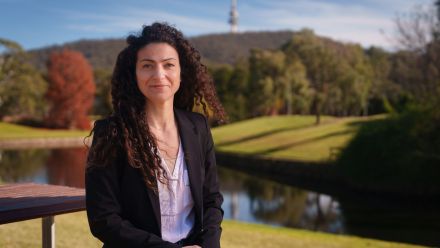
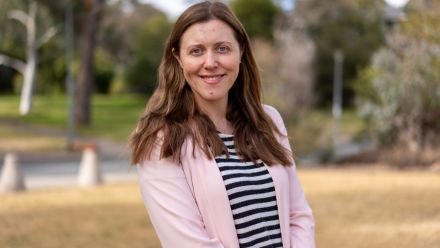
ANU expert Dr Sima Mousavi has been recognised for uncovering hidden earthquake faults across Australia and inspiring the next generation of Earth scientists.
Australia might be known as a geologically quiet continent, but earthquakes occur more often than many people realise, and some of the faults responsible remain hidden beneath our feet.
Earth sciences researcher Dr Sima Mousavi from The Australian National University (ANU) is helping uncover these hidden earthquake sources and better understand the risks they pose to Australian communities.
Her work has earned her a 2026 Young Tall Poppy of the Year Science Award, recognising her research into where and why earthquakes occur, as well as her commitment to bringing Earth science into classrooms across Australia.
Dr Mousavi, from the ANU Research School of Earth Sciences, was announced as the overall 2026 Australian Capital Territory (ACT) winner at the Young Tall Poppy Gala Dinner on 11 September.
Dr Mousavi uses vibrations called seismic waves to image the planet’s internal structure, from the crust to the deep Earth, much like a doctor uses CT scans to see inside the human body.
Her research investigates where earthquakes occur, why they happen, and how the faults that produce them rupture.
Among her work, Dr Mousavi led the first comprehensive study of the source of the magnitude 5.9 Woods Point earthquake that struck Victoria in 2021. Her research identified the previously unknown fault responsible for the earthquake, showing how hidden geological structures can pose seismic hazards even in regions considered relatively stable.
She is now extending this research to other significant Australian events, including the 2019 magnitude 6.6 Broome offshore earthquake and the 2025 Brisbane earthquake sequence, helping build a clearer picture of seismic risk across the country.
But for Dr Mousavi, understanding what happens beneath the Earth’s surface is only part of the job.
She also leads the Australian Seismometers in Schools (AuSIS) program, bringing research-grade seismometers to schools to give young people the opportunity to work with real earthquake data.
Since 2019, Dr Mousavi has delivered more than 250 workshops and professional development sessions for students and teachers across Australia, with a particular focus on regional, remote and First Nations communities.
One of the most rewarding parts of the program, she says, is seeing students discover that a career in science could be possible for them.
“I love being able to show students that science isn’t something that only happens in a university laboratory,” says Dr Mousavi.
“They can actually look at a seismic recording from their own school and investigate an earthquake themselves.
“That combination of discovering things about the Earth myself and then passing that curiosity on to the next generation, is what I enjoy most about what I do.”
Her outreach comes at a time when Earth science expertise is increasingly important to Australia, supporting work in areas including natural hazard assessment, critical minerals, groundwater management and the energy transition.
The Australian Institute of Policy and Science (AIPS) Young Tall Poppy Awards celebrate outstanding early-career researchers who are passionate about engaging the wider community.
As a Tall Poppy, Dr Mousavi joins a national network of science ambassadors working with schools and communities to encourage greater engagement with science and inspire the next generation of researchers.
Exploring beneath the Earth’s crust, uncovering hidden earthquake sources and helping young people see themselves in science are just some of the ways Dr Mousavi is helping shape the future.
Read about the Tall Poppy Awards on the AIPS website.