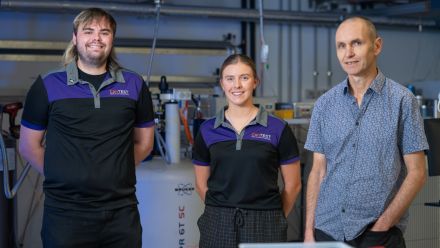
“The pipeline of graduates coming out of ANU in computing, physics and engineering is genuinely world-class, and the innovation community here punches well above its weight. We’re in Canberra because it works.”
Canberra-based technology company Liquid Instruments has secured major investment to accelerate the commercialisation of its platform that is reshaping how engineers interact with complex systems.
The $70 million Series C round was co-led by Keysight Technologies, California-based global leader in engineering design and innovation software, and the Australian Government’s National Reconstruction Fund Corporation (NRFC).
As well as investing, Keysight will partner with Liquid Instruments to develop a new class of AI-driven instrumentation.
Liquid Instruments was founded on research developed at ANU and NASA’s Jet Propulsion Laboratory. The company’s approach to test and measurement involves consolidating multiple instruments into a single reconfigurable platform where users can create and deploy their own custom measurement solutions.
The platform has thousands of users across 30 countries, including leading tech companies, research institutes, quantum startups and defence primes.
Professor Daniel Shaddock, CEO and co-founder of Liquid Instruments, said: “Keysight has long set the standard for precision, innovation and trust in its solutions for the most complex engineering challenges, and its investment is a strong validation of our approach.
“As systems grow more complex, our users need more flexible, AI-driven tools, and this new partnership with Keysight will accelerate that shift.”
Professor Shaddock, who is a former Professor of Physics in the ANU College of Science and Medicine, said the company’s decision to remain headquartered in Canberra reflects the strength of the city’s innovation ecosystem.
“ANU gave us our first funding and the foundation to build from,” he said.
“The pipeline of graduates coming out of ANU in computing, physics and engineering is genuinely world-class, and the innovation community here punches well above its weight. We’re in Canberra because it works.”
Joaquin Torrecilla, Vice President of Software Transformation at Keysight, said the partnership reflects a broader shift in how the industry approaches test infrastructure.
“The industry is shifting toward software-first and AI-enabled architectures,” Torrecilla said.
“Liquid Instruments extends this by using software and AI to directly shape hardware behaviour, creating more adaptable instrumentation. Together with Keysight’s extensive portfolio, this enables more scalable and integrated test solutions.”
Mary Manning, Chief Investment Officer at NRFC, said the government’s investment in Liquid Instruments reflects its commitment to supporting Australian technology companies scaling globally in critical sectors.
“Liquid Instruments exemplifies the kind of high-impact innovation that strengthens sovereign capability while competing on the world stage,” Manning said.
The funding will be used to accelerate product development, scale Liquid Instruments’ AI-powered platform Moku, and expand go-to-market activity in aerospace and defence industries as well as the semiconductor manufacturing sector.
ANU Professor Brian Schmidt, Nobel Laureate and Liquid Instruments board member, said that advances in instrumentation are central to scientific discovery.
“More adaptable and accessible measurement technologies enable researchers and engineers to explore problems that were previously out of reach, accelerating progress across both fundamental science and applied engineering,” he said.