Researchers from The Australian National University (ANU) have engineered new optical coatings for LIGO, the global collaboration hunting gravitational waves from colliding black holes and neutron stars.
The ANU team has spent three years developing and applying advanced coatings to two highly specialised beamsplitters for LIGO (Laser Interferometer Gravitational-Wave Observatory), part of an upgrade that will help scientists detect gravitational waves with greater sensitivity than ever before.
Australia’s contribution to LIGO is coordinated through OzGrav, the ARC Centre of Excellence for Gravitational Wave Discovery.
First predicted by Albert Einstein more than a century ago, gravitational waves – tiny ripples in space-time caused by some of the universe’s most powerful events – were directly detected for the first time in 2015, opening a new way of studying the universe.
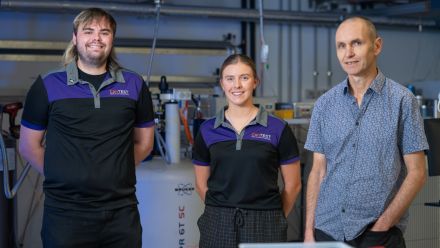
Professor Steve Madden from the ANU Research School of Physics and Director of the Australian National Fabrication Facility (ANFF)’s OptoFab ACT Hub, said these are some of the most exacting and precise coatings ever made.
“We spent three years on very challenging research and development and put our heart and soul into building these optics,” Professor Madden said.
“We really want to see this Australian contribution produce great results for international science.”
Professor Robert Ward, Director of the Centre for Gravitational Astrophysics at the ANU, a joint facility between the Research School of Physics and the Research School of Astronomy and Astrophysics, said the project drove precision optics to unprecedented levels.
“You need exquisite measurement precision, very tightly controlled processes and extreme coating thickness uniformity to build these components,” Professor Ward said.
“We’re coating this glass to within a nanometre or two across almost half a metre – a few atoms’ difference from one edge to the other.”
Detecting gravitational waves requires measuring changes in distance around a millionth of a billionth the width of a human hair, using an extremely pure laser beam as a precision ruler. Any tiny change caused by a passing gravitational wave shows up in the resulting light pattern.
Each beamsplitter is a 45-centimetre disc made from some of the purest glass in the world, weighing more than 20kg.
The coating on one side splits the laser beam precisely in half; on the other, an ultra-low-reflectivity coating more than 1,000 times more effective than an ordinary spectacle lens coating minimises interference and improves detector sensitivity.
ANU is one of only two groups worldwide capable of producing these coatings to the exacting standards required for gravitational wave detection.
Deon Hickey from ANFF OptoFab ACT said achieving the required precision involved developing entirely new approaches to manufacturing and measurement.
“Every component that goes into this detector is pushed to the absolute limit,” Hickey said.
“There aren't many machines in the world that can meet the requirements, so we had to build our own equipment and find new ways to solve the problems.”
The team needed to control coating thicknesses with almost single atomic layer accuracy across the entire surface, while also ensuring the optics remained exceptionally clean and free from microscopic defects.
To achieve this, the researchers developed eight custom automated systems to clean, measure and handle the delicate components without human contact.
The project brought together expertise from across ANU, including the Research School of Physics, the Centre for Gravitational Astrophysics and the ANFF OptoFab ACT node at ANU.
The work was completed inside the new ANU Research School of Physics Clean Room, where the cleanliness requirements matched those used in advanced semiconductor manufacturing facilities.
The upgraded detectors will help researchers pick up more gravitational wave events, including weaker signals from further away, and study the behaviour of some of the universe’s most mysterious objects in greater detail.
The achievement highlights Australia’s contribution to one of the world’s largest scientific collaborations and demonstrates the University’s capability in developing the advanced technologies needed to support next-generation astronomical discovery.